
The IRS raised the 2027 limits for FSAs, HSAs, Commuter Benefits and HRAs. This guide explains each one in plain language so you can plan your benefit elections with confidence.
On Nov. 5, 2026, the IRS released Revenue Procedure 2026-35 with the new 2027 limits for Flexible Spending Accounts (FSAs), Commuter Benefits, and Health Reimbursement Arrangements (HRAs). The Health Savings Account (HSA) limits came out earlier this year, on May 29. Most of these numbers went up, so in 2027 you can set aside more pre-tax money for health care, child care, and your commute.
If you’re choosing your benefits during open enrollment, these are the numbers to know.
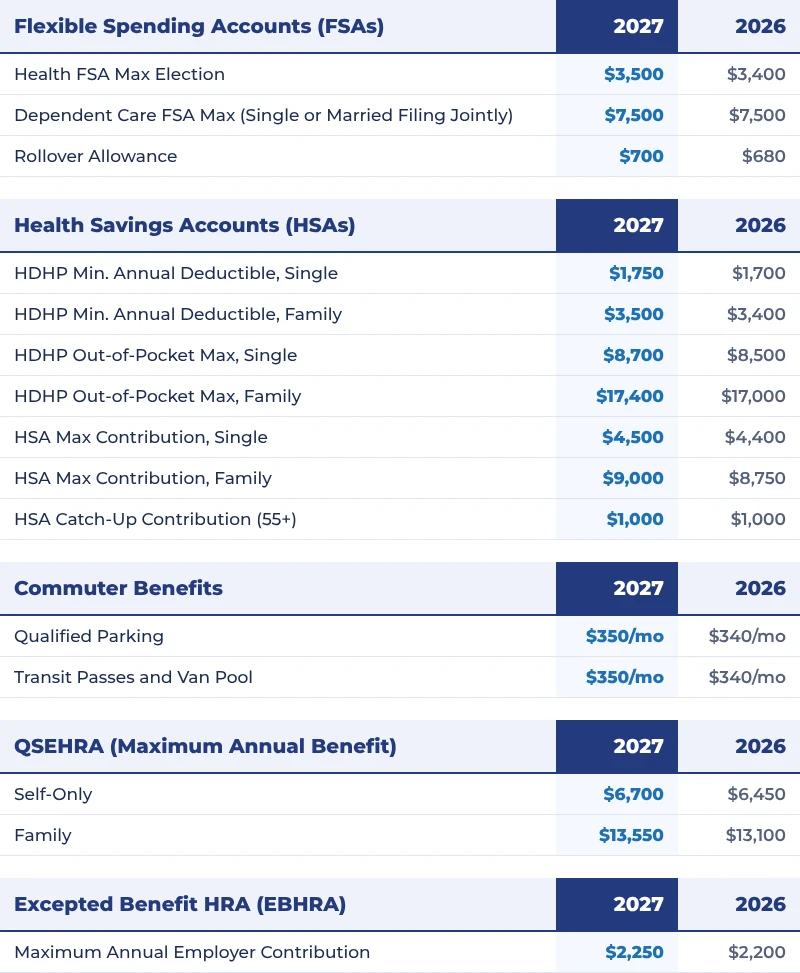
Your 2027 limits at a glance:
Health FSA: $3,500 for 2027
A Health FSA lets you set aside money from your paycheck before taxes to pay for everyday medical costs like copays, prescriptions, dental work and glasses. For 2027, you can contribute up to $3,500, which is $100 more than in 2026.
If your employer’s plan offers a carryover, you can roll up to $700 of unused money into 2028 (up from $680). Not every plan has a carryover, and some use a grace period instead, so check your plan details before you decide how much to elect.
A good way to pick your amount is to look at what you spent this year. For example, if you know you’ll need new glasses for about $300 and you pay $25 a month for a prescription, that’s $600 you can plan for right away.
Dependent Care FSA: $7,500 per household
The dependent care FSA limit stays at $7,500 for 2027 for single filers and married couples filing jointly. If you’re married and file separately, the limit is $3,750. You can use this account to pay for daycare, preschool, before- and after-school programs, and summer day camp for children under 13.
This is a household limit. If you and your spouse both have a Dependent Care FSA through work, your combined contributions can’t go over $7,500.
HSA: $4,500 single, $9,000 family
An HSA works with a High-Deductible Health Plan (HDHP). For 2027, you can contribute up to $4,500 with self-only coverage or $9,000 with family coverage. If you’re 55 or older, you can add another $1,000 as a catch-up contribution.
These limits include any money your employer puts into your HSA. So if your employer contributes $1,000 to your family HSA, you can add up to $8,000 yourself.
The money in your HSA is yours to keep. It rolls over every year, and it stays with you if you change jobs.
To qualify for an HSA in 2027, your health plan needs a deductible of at least $1,750 for self-only coverage or $3,500 for family coverage. The most you’ll pay out of pocket is $8,700 for self-only coverage or $17,400 for family coverage.
Commuter Benefits: $350 a month
Commuter Benefits let you pay for work travel with pre-tax money. In 2027, you can set aside up to $350 a month for transit passes and vanpools, plus up to $350 a month for qualified parking. These are separate limits, so if you drive to a train station and park there, you can use both.
HRAs your employer may offer
Some employers pay for health costs through an HRA. You don’t contribute to these accounts, because your employer funds them and decides how much to offer, up to the IRS limits.
A QSEHRA is for small employers with fewer than 50 full-time employees. It reimburses you for individual health insurance premiums and medical expenses, up to $6,700 for self-only coverage or $13,550 for family coverage in 2027.
An Excepted Benefit HRA (EBHRA) can pay up to $2,250 in 2027 for costs like dental and vision premiums.
Planning for next year
Open enrollment is a good time to look at what you spent this year and set your 2027 amounts based on real numbers rather than guesses. If you’re not sure how a limit applies to you, or you want help figuring out how much to set aside, call the HRPro support team at 248-543-2644 and we’ll walk through it with you.