Your Turnover Problem Started Long Before Someone Quit
A rough first week, a silent foreman, or a rushed exit interview all leave a mark. Here’s how the entire employee experience shapes whether skilled workers stay on your crew.
You wouldn’t wait until the end of a project to find out where it went wrong. You’d catch the framing error before drywall went up, and you’d fix the schedule slip before it delayed three other trades. So why do most construction companies wait until someone turns in their hard hat to figure out where the employee experience broke down?
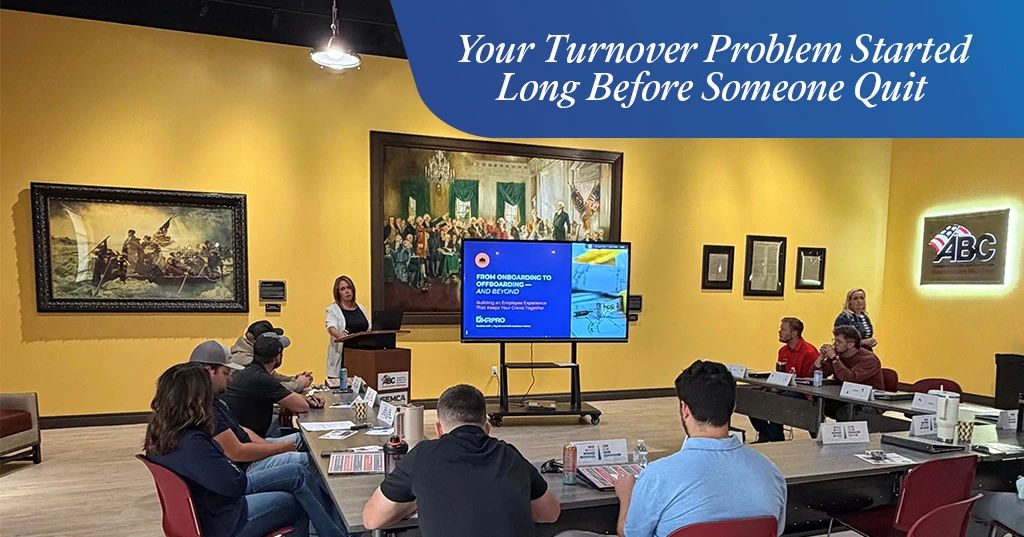
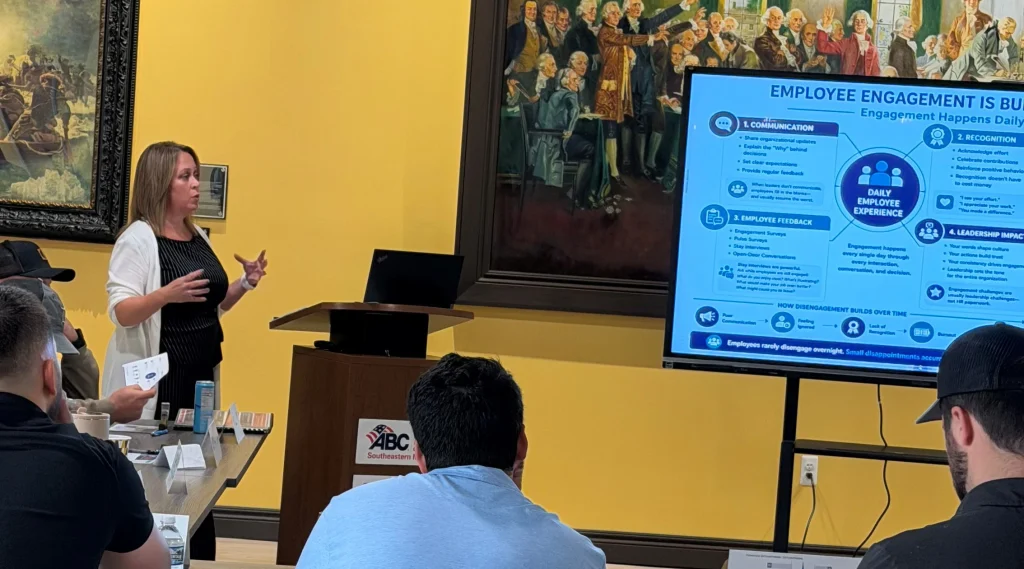
HRPro was invited to speak on this exact topic last week at ABC SEMI’s Construction Leadership Institute, presenting “From Onboarding to Offboarding, and Beyond” to a room of owners, project leaders, and HR professionals from across the construction industry. The conversation in that room kept circling back to one idea: turnover is rarely a single event. It’s the final entry in a long list of small moments, and most of them happened long before anyone resigned.
Hiring Sets the Tone Before Day One
Skilled trades are in short supply, and the good candidates know it. They’re checking your reviews, asking around the job trailer, and comparing more than your hourly rate before they ever fill out an application. A vague job posting that skips over travel requirements, shift length, or site conditions doesn’t just attract the wrong fit. It plants the seed for a resignation six months down the road, once the new hire realizes the job isn’t what they signed up for.
Companies that hire well aren’t necessarily hiring faster. They’re hiring with more clarity. Clear postings, consistent interview questions, and a process that treats every candidate the same way build trust before the first day even starts.
The First 90 Days Decide More Than You Think
Ask any superintendent about a hire who didn’t work out, and they can usually trace it back to the first week or two. Nobody had the badge ready. The crew didn’t know who was showing up. The new guy stood around for an hour waiting on direction, and that confusion followed him for months.
Onboarding isn’t a single orientation morning. It’s everything that happens in the first 90 days: whether expectations are clear, whether someone on the crew took the time to make an introduction, and whether the required paperwork felt like a formality or a hassle. A tradesperson who starts strong is more likely to stay strong. A tradesperson who spends their first week guessing is already halfway out the door.
Engagement Happens on the Jobsite, Not in a Survey
Nobody disengages overnight. It happens in small increments, one missed conversation at a time. A foreman who doesn’t explain why a schedule changed leaves the crew to assume the worst. A supervisor who never says “good work” after a long, hot pour sends a message just as loud as one who does say it, just in the opposite direction.
This is where a lot of companies get the ownership backward. Engagement doesn’t come from an annual survey sent out by HR. It comes from communication, recognition, and feedback that happen daily, and it’s driven almost entirely by foremen and site supervisors, not the front office. If your leadership team hasn’t connected engagement to field leadership, that’s the gap worth closing first.
A Great Tradesperson Isn’t Automatically a Great Foreman
Plenty of companies promote their strongest hands into supervisory roles and assume the leadership will follow naturally. Sometimes it does. Often it doesn’t, because running a crew and swinging a hammer are two different skill sets. Coaching, delegating, and holding people accountable have to be taught, the same way a new apprentice has to be taught to read a set of plans.
Development doesn’t always mean a formal promotion path. Cross-training, certifications, and stretch assignments all send the same signal: there’s a future here worth sticking around for. Take that signal away, and even your most talented people start looking elsewhere, not because they’re unhappy with the pay, but because they can’t see what comes next.
Pay Gets Them In the Door. Something Else Keeps Them There.
Compensation matters, and it should be competitive, fair, and transparent. But pay alone rarely explains why someone stays for ten years or leaves after ten months. Employees weigh the whole package: benefits, schedule flexibility, stability during slow seasons, and whether their effort gets noticed. Two companies can offer the same hourly rate and land in very different places on retention, because one of them built a total experience worth staying for.
Read the Signals Before You Read the Resignation
Seasonal swings are a normal part of construction, but unexplained turnover isn’t. When someone leaves, the more useful question isn’t “why did they leave?” It’s “what did we miss?” Had they stopped speaking up in meetings? Had their attendance slipped? Were they passed over for a project they’d asked about? Patterns across a project, a crew, or a supervisor tell you more than any single exit interview ever will.
The Exit Is Still Part of the Job
How a company handles someone’s last two weeks says as much about its culture as how it handled their first two. Final paychecks, benefits questions, and a respectful handoff of responsibilities all matter, and they all get remembered. In a trade community where everyone seems to know everyone, a former employee’s opinion of you travels fast, whether it’s a referral for a skilled friend or a warning to stay away.
Health coverage is often one of the most stressful parts of that exit for a departing employee. Many companies now lean on partners like MyCarePro to walk former employees through COBRA and alternative coverage options, so the last conversation someone has with your company is a helpful one instead of a confusing one.
The Takeaway
Every stage of the employee lifecycle leans on the one before it. A weak hiring process makes onboarding harder. A rough first 90 days makes engagement harder. Low engagement makes development and retention harder. And a respectful exit is what keeps the door open for referrals, subcontractor relationships, and boomerang hires down the road. None of these stages work in isolation, and treating turnover as a single, late-stage problem means missing everything that happened before it.
If you’re only looking at the employee experience when someone hands in their notice, you’re reading the last page of a much longer story.
HRPro works alongside construction companies on the pieces that make this lifecycle easier to manage well, from payroll and HRIS technology to benefits administration and HR consulting. If you want a second set of eyes on where your employee experience might be leaking talent, that’s a conversation worth having before your next hire, not after your next exit interview.